
For this series of interviews, I’ve chosen 8 questions as a tribute to the iconic 8mm camera, diving into the vision and passion of each filmmaker/actor.
Andrew Walsh is an Australian director and writer, known for his work in both short films and feature films.
Is there a movie from your childhood that sparked your love for cinema, or was it something that developed gradually?
It wasn’t really my childhood so much. I grew up in a regional town in South Australia, where the nearest city was a five-hour drive away. When you’re a child, it may as well be on another planet. I was too busy being outside – skateboarding, BMX, hockey, football, the beach – just running amok, really. I was never a huge anime fan, but in high school, I came across Neon Genesis Evangelion, which had a profound effect on me. It was like nothing I’d ever seen before, and then I read later on that creator Hideaki Anno created this entire fictional universe based on his struggles with his mental health.
That’s what truly great art is – it’s being vulnerable, it’s showing people something that is real. That takes courage. Then the film End of Evangelion came out and changed everything. Hideaki Anno broke every possible rule and convention of traditional filmmaking. He took his personal trauma and turned it into a universal masterpiece.
Then, around 17 years old, I began to discover films from all over the world. It was definitely the lower-budget American indie films that felt like something within my reach as a storyteller.
Which filmmaker inspires you the most, and why?
Spike Lee, because he does his work without compromise. A lot of filmmakers achieve success, and success makes them complacent. Spike Lee is constantly trying new things, pushing boundaries, learning, and growing. His work is thought-provoking. He has an understanding of humanity that very few people have. Spike Lee understands what’s happening to people and society and the way it’s going—the kind of stuff that everyone knows deep down in their gut but doesn’t want to face up to or say out loud. Spike Lee makes films about it.
If you could organize your own film festival, what kind of films would you show, and why?
The first thing I would do is make it free entry for all! Most modern film festivals these days are a cynical, money-making scam that takes advantage of vulnerable artists – of which there is no shortage – who just want to show their work to the world.
It would be a mix of all genres. There are only two kinds of films: good films and bad films. I’d only be playing good films. Short films and features.
One thing I would love to do is hold a retrospective screening of the works of Alkinos Tsilimidos. In my opinion, he is the greatest filmmaker Australia has ever produced, and nobody knows who he is. He has directed six innovative, profound feature films that redefined cinema culture in our country but, unfortunately, were not successful on a commercial scale. I saw one of his films, Em 4 Jay, and it was doing so badly in the cinema that the staff let me in for free. I was the only person there. He deserves better.
What’s a challenge you’ve faced as a filmmaker/actor, and how did you overcome it?
Self-doubt and low self-esteem. I heard this line in a song: “The man in the mirror is my only opponent,” which sums me up well. People think I’m a confident person and filmmaker, but I constantly battle with the idea that I’m not good enough or that I’m not meeting my own expectations, which are much higher than those of anyone who enjoys my films. I don’t know if I’ve overcome it.
There have been a thousand times I’ve wanted to give it all up. I almost gave up on How Deep Is The Ocean early in pre-production because the stress was overwhelming. Thankfully, my partner and my producers, Dia Taylor and Daniela Ercoli, convinced me to keep going.
Even after creating a feature film out of nothing, getting international distribution, and achieving all these milestones, it still doesn’t feel like enough. It’s just something I have to live with day to day. At the end of the day, success does not guarantee happiness.
Can you describe a moment on set that has left a lasting impression on you?
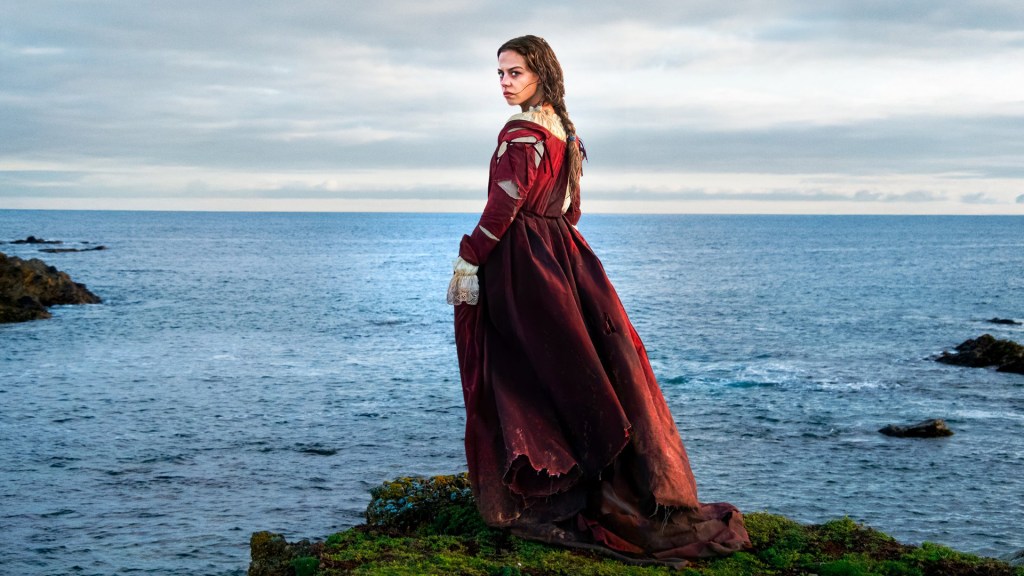
Probably the final day of shooting How Deep Is The Ocean will stay with me always. We arrived on Williamstown Beach on a bitterly cold morning. The temperature was low, and the waves were rough. We were there to shoot the climactic baptism scene where Eleanor (Olivia Fildes) goes into the water and metaphorically lets go of her past and her mistakes.
However, once we got there, the entire crew looked at me and said, “I don’t think we can do this.” I then ripped off my clothes, ran headfirst into the water, and swam in the current, waving to the crew who were on the shore.
Once they saw me lead by example, they all got into the water, and we captured that beautiful sequence. It was an emotional moment for all of us. I feel like we all got back onto land, and something about us had changed for the better.
If you had the chance to make a film about your own life, what genre would it be, and who would play you?
It would be titled “Twenty-Three Odd Years,” as that marks when I wrote my first-ever script. It would be filmed in an absurdist style, like Birdman, Curb Your Enthusiasm, or Bad Lieutenant (the Werner Herzog version). I’ve encountered many surreal and absurd situations in my career. Cillian Murphy would play me. It wouldn’t be easy – he’s a good-looking man. Our makeup department would have to mess him up good to look like me.
What are your top three favorite movies of all time, and what makes them so special to you?
It’s difficult to define my favourites of all time. The more I see, the more it changes. Right now, here are the three films I couldn’t live without.
The first one is a film simply titled War. I’m sure there are many films called War, but this is a Russian film released in 2002. The story is set during the second war between Russia and Chechnya. Conscripted soldier Ivan and English actors John and his girlfriend Margaret are kidnapped by fearsome warlord Aslan while performing near Chechnya. Aslan releases Ivan and John, declaring a two-million-dollar ransom to release Margaret. Faced with indifference and incompetence from both the Russian and English governments and the media at every turn, Ivan and John end up sneaking back into the hostile nation to mount a rescue mission. Armed with only a single hunting rifle, they proceed to take on an entire army.
I haven’t seen many Russian films, but I notice this clever pattern of distrust and contempt for authority. I suppose people have to be very careful what they say over there, so they express ideas with this wonderful black gallows humour. It’s a very subversive film, showing the contrasts between life in the Western world and the Russian Federation. Like any good action film, there’s a shootout with the bad guys at the end.
Then there’s Last Life In The Universe. It’s a Thai film set in Bangkok about a Japanese librarian who forms an unlikely friendship with a woman as they are united by tragedy. Even though it tackles heavy subjects—loneliness, suicide, grief—the film’s ambient music, the warm colour tones, and the slow, gentle pace make you feel like you’re wrapped in a warm blanket on a cold day. It’s like everything else in life has the volume turned way down. After watching it, I feel like I had a good night’s sleep with vivid dreams. It’s a transcendent experience. Very few films can do that to someone.
Last but not least would be Slap Shot by the great George Roy Hill, simply because Paul Newman is in it. You can never go wrong with Paul Newman. In this film, Newman plays Reggie Dunlop, a coach of a failing ice hockey team, the Charlestown Chiefs, who takes them for one last shot at glory when they find out their club is broke and it will be their final season. It’s violent, obscene, and hilarious.
If you could share one life lesson with our readers, what would it be?
Just keep going, and no matter how bad things get, never give up.
If you want to know more about filmmaker Andrew Walsh, take a look here!

 aeyenah